Explore our comprehensive catalog of micro-credential courses designed to boost your skills and career. Flexible, industry-aligned, and recognized by employers.
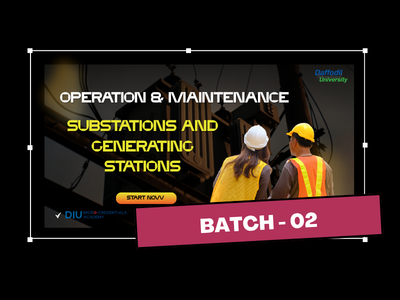
With the rapid expansion of industrial zones, power plants, EPZs, Hi-Tech Parks, and modern electrical infrastructure in Bangladesh, the demand for skilled professionals in substation and generator operation & maintenance is growing significantly.
Although many engineers and technicians graduate with strong theoretical knowledge, there remains a critical skills gap in hands-on operation, fault diagnosis, safety compliance, and maintenance of live electrical systems such as 33/11 kV substations and industrial generating stations.
Industries now seek professionals who can operate equipment confidently, follow safety standards, reduce downtime, and ensure uninterrupted power supply. This micro-credential course directly responds to that industry demand by delivering practical, site-based, and industry-aligned training.
This course aims to:
Provide hands-on training in the operation and maintenance of industrial substations and generating stations
Develop practical skills in handling transformers, switchgear, LT panels, generators, and protection systems
Enhance understanding of industrial load management, grounding, and safety protocols
Familiarize learners with real-world equipment, testing methods, and troubleshooting techniques
Introduction to 33/11 kV and 11/0.415 kV substations
Substation layout, HT & LT switchgear
Power transformers: operation, protection, and maintenance
Industrial LT distribution systems & load management
Diesel and gas generator installation, operation & maintenance
Battery banks, DC systems, grounding & lightning protection
Electrical safety standards (BNBC, IEC, NFPA)
Industrial site visits and final practical evaluation
After completing the course, participants will be able to:
Diploma and BSc-level engineering students (EEE, Power, Mechanical)
Substation and generator operators or technicians
Junior field engineers and maintenance personnel
Professionals from factories, power plants, EPZs, and EPC companies
After completing this micro-credential, learners may:
Class participation & attendance – 10%
Weekly quizzes / viva – 20%
Practical skill evaluation / group project – 40%
Field visit report – 10%
Final practical evaluation & demonstration – 20%
Multimedia-equipped classrooms
Functional 33/11 kV and 11/0.415 kV substations
Industrial generator stations
Battery banks, DC systems, and protection panels
Insulation Resistance (IR) testers
Earth resistance testers
Transformer oil testing kits
Multimeters, clamp meters
PPE, LOTO kits, relay testing equipment
Course manual & handbook
Weekly presentation slides
Maintenance checklists
Field visit logbook
Safety standards documentation (BNBC, IEC, NFPA)
The following discounts currently apply:






Join thousands of students already enrolled
Md. Habibur Rahman: BSc in Food Engineering and Tea Technology (SUST, Sylhet)
MSc in Nutrition and Food Science (University of South Asia, Banani, Dhaka)
MBA in Supply Chain Management (BUP, Mirpur Cantonment, Dhaka)
About 12 years of experience in the tea industry (MM Ispahani Tea Ltd., BRAC
Tea Estates Ltd., City Group Tea Estates Ltd., ACME Consumer Products Ltd. -
Tea & beverage Unit, Kazi & Kazi Tea estate Ltd.)
Dr. Atiqual Islam: Assistant Professor & Associate Head, Daffodil International University
PhD and Postdoc – South Korea
(Analytical chemistry, Chromatographic method development)
Profile: https://faculty.daffodilvarsity.edu.bd/profile/nfe/atiqual.html
Dr. Md. Al Mamunur Rashid: Assistant Professor, Daffodil International University
PhD and Postdoc – South Korea
(Food Chemistry, Nutrition, Computational Chemistry, Polymerization)
Profile: https://faculty.daffodilvarsity.edu.bd/profile/nfe/mamunur.html
Md. Monirujjaman: Lecturer (Senior Scale), Daffodil International University
B.Sc. & M.S in Food Engineering (Food Engineering, Bioactive Compound Extraction, Sustainable Food
Processing)
Profile: https://faculty.daffodilvarsity.edu.bd/profile/nfe/monirujjaman.html
Duration: 16 Hours
Delivery Mode: Blended: In-person and online, site visit | Class Size: 20
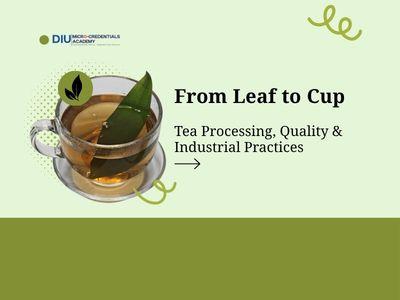
This course integrates industry-based knowledge with academic learning, offering practical insights into tea manufacturing, quality management, and product innovation.
It is designed to bridge the gap between academic knowledge and practical industry requirements, supporting entrepreneurship and value-added tea businesses.
The global tea industry is rapidly evolving with increasing demand for premium, specialty, and functional tea products. As a key tea-producing country, Bangladesh has strong potential in both domestic and export markets, yet faces a shortage of skilled professionals in tea processing, quality assurance, and value addition. At the same time, a gap persists between academic knowledge and practical industry requirements, limiting employability and productivity.
This micro-credential course aims to bridge that gap by integrating industry-based knowledge with academic learning, offering practical insights into tea manufacturing, quality management, and product innovation. It will also support entrepreneurship and value-added tea businesses. By developing industry-ready skills, the course will enhance competitiveness, promote sustainable practices, and contribute to the overall growth of the tea sector.
Specific: Enable learners to understand and apply modern tea processing techniques, including withering, rolling, fermentation, drying, and packaging.
Measurable: Ensure learners can perform quality assessment and tea tasting for at least three types of tea and evaluate their quality using industry standards.
Achievable: Equip learners with practical skills in tea blending, cost control, and inventory management through hands-on exercises and case studies.
Relevant: Prepare learners for employment or entrepreneurship in tea estates, beverage industries, and tea-based businesses by providing industry-relevant knowledge.
Time-bound: By the end of the course, learners will demonstrate proficiency in tea production operations, quality assurance practices, and value-added product development through assessments and practical projects.
Introduction to the tea industry, course guidelines, global and Bangladesh tea sector overview, Q/A
Tea plant, cultivation practices, plucking methods, types of tea (black, green, oolong, white), Q/A
Withering process, rolling and CTC method, fermentation (oxidation) principles, processing parameters
Drying and firing techniques, grading and sorting, packaging methods, storage conditions
Tea quality parameters, liquor characteristics, aroma and flavor, tea tasting techniques, sensory evaluation
Chemical composition of tea, quality indicators, basic laboratory analysis, Q/A
Tea blending techniques, specialty and functional tea, product development concepts
Industrial tea processing workflow, factory operations, cost control, inventory management
Quality assurance systems (GMP, HACCP basics), hygiene and safety in tea industry
Tea business opportunities, branding and marketing strategies, export potential and regulations
Case study on tea processing and quality control, problem-solving session
Tea tasting session (minimum three types), practical evaluation and data recording
Development of value-added tea product, group project work, presentation
Industry visit (tea factory) / virtual tour, observation and report preparation
Final assessment: practical, project presentation, viva
They will learn to
Demonstrate tea processing techniques (withering, rolling, fermentation, drying) through practical application
Evaluate tea quality using standard sensory parameters (color, aroma, flavor, liquor) for at least three tea types
Apply basic quality control and safety principles (GMP, HACCP) in tea production
Develop a value-added tea product and perform basic blending
Analyze tea processing operations and prepare a brief technical or business report
Students (graduate/undergraduate) of Food Technology, Food Engineering, Chemistry, Food and Nutrition, professionals, and entrepreneurs.
Higher studies in Food Engineering, Food Technology, Nutrition, or Beverage Science
Entry- to mid-level roles in the tea and beverage industries (processing, quality control, production)
Internship and industrial training in tea estates and tea processing factories
Career as a sensory evaluator or tea quality analyst
Entrepreneurship in tea-based businesses (tea blending, specialty tea, tea cafés, value-added products
Tea processing equipment
Sensory evaluation setup
Basic lab facilities
Classroom & multimedia support
Learning materials & LMS
Industry visit/virtual tour
Safety and hygiene items
Quizzes,
Project work
Report writing
Viva
Awarded a Certificate of Completion by the DIU Micro-Credentials Academy.
Tentative Course Fee: 2,500 BDT




Join thousands of students already enrolled
Try adjusting your filters to see more courses.
