Master practical skills in our micro-credentials class with expert-led, hands-on sessions!
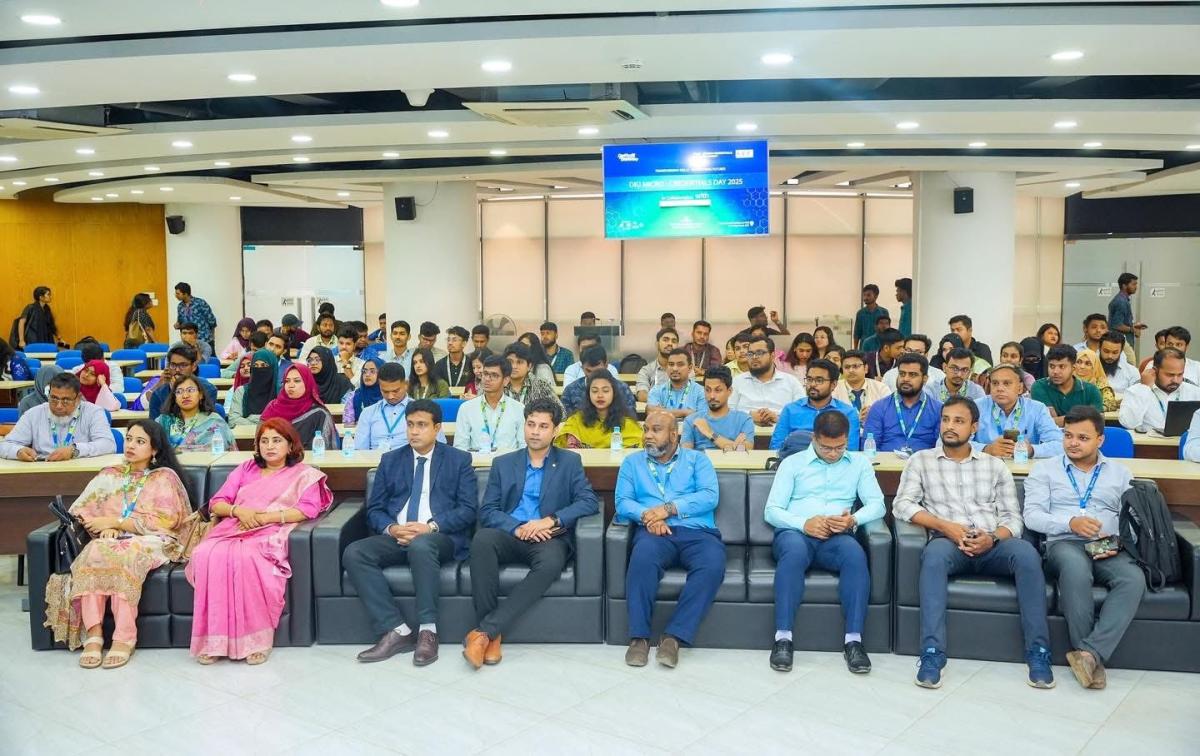
Step back to our inspiring July 19 event, where top industry experts from DIUMCA showcased a variety of micro-credentials courses and delivered an empowering motivational lecture to inspire future learners!
With the rapid expansion of industrial zones, power plants, EPZs, Hi-Tech Parks, and modern electrical infrastructure in Bangladesh, the demand for skilled professionals in substation and generator operation & maintenance is growing significantly.
Although many engineers and technicians graduate with strong theoretical knowledge, there remains a critical skills gap in hands-on operation, fault diagnosis, safety compliance, and maintenance of live electrical systems such as 33/11 kV substations and industrial generating stations.
Industries now seek professionals who can operate equipment confidently, follow safety standards, reduce downtime, and ensure uninterrupted power supply. This micro-credential course directly responds to that industry demand by delivering practical, site-based, and industry-aligned training.
This course aims to:
Provide hands-on training in the operation and maintenance of industrial substations and generating stations
Develop practical skills in handling transformers, switchgear, LT panels, generators, and protection systems
Enhance understanding of industrial load management, grounding, and safety protocols
Familiarize learners with real-world equipment, testing methods, and troubleshooting techniques
Introduction to 33/11 kV and 11/0.415 kV substations
Substation layout, HT & LT switchgear
Power transformers: operation, protection, and maintenance
Industrial LT distribution systems & load management
Diesel and gas generator installation, operation & maintenance
Battery banks, DC systems, grounding & lightning protection
Electrical safety standards (BNBC, IEC, NFPA)
Industrial site visits and final practical evaluation
After completing the course, participants will be able to:
Diploma and BSc-level engineering students (EEE, Power, Mechanical)
Substation and generator operators or technicians
Junior field engineers and maintenance personnel
Professionals from factories, power plants, EPZs, and EPC companies
After completing this micro-credential, learners may:
Class participation & attendance – 10%
Weekly quizzes / viva – 20%
Practical skill evaluation / group project – 40%
Field visit report – 10%
Final practical evaluation & demonstration – 20%
Multimedia-equipped classrooms
Functional 33/11 kV and 11/0.415 kV substations
Industrial generator stations
Battery banks, DC systems, and protection panels
Insulation Resistance (IR) testers
Earth resistance testers
Transformer oil testing kits
Multimeters, clamp meters
PPE, LOTO kits, relay testing equipment
Course manual & handbook
Weekly presentation slides
Maintenance checklists
Field visit logbook
Safety standards documentation (BNBC, IEC, NFPA)
The following discounts currently apply:






Join thousands of students already enrolled
Md. Istiak Hossain Joy, Lecturer, Department of Agricultural Science (AGS), Daffodil International University (DIU).
Dr. Shihab Uddin, Assistant Professor, Department of Soil Science, Bangladesh Agricultural University (BAU).
Atiqur Rahman, Scientific Officer, Plant Breeding Division, Bangladesh Rice Research Institute (BRRI).
⏱ Duration: 06 Weeks | 16–18 Hours (10–12 Sessions) | Mode: Online (Google Meet)
This micro-credential course equips agriculture and environmental science students with practical, workbench-level competencies in statistical data analysis, visualization using R and RStudio, academic thesis formulation, scientific report writing, and journal manuscript submission. Additionally, it provides structured coaching for agricultural research station job preparation, covering recruitment procedures, written technical assessments, and interview strategies.
Agriculture students often lack practical skills in advanced data analysis using RStudio, academic thesis writing, scientific report preparation, and journal article submission. They also have limited exposure to agricultural research station recruitment procedures, technical examinations, and interview preparation. These gaps reduce their readiness for higher education, research publication, and professional employment. Training in RStudio, data visualization, thesis composition, and job screening addresses this critical skill gap.
The course aims to equip agriculture students with practical skills in advanced data analysis using RStudio, academic thesis writing, scientific report preparation, research article submission, and agricultural research station job preparation, enhancing their research competencies and career readiness.
Specific objectives include:
Develop practical skills in statistical data analysis, interpretation, and visualization using R and RStudio.
Equip learners with standard academic thesis writing, research organization, citation, and referencing conventions.
Build competencies in scientific report writing, manuscript preparation, journal selection, and submission procedures.
Prepare candidates for agricultural research station recruitment through guidance on written exams, technical assessments, and interview dynamics.
Module 1: Introduction to Research Methodology and RStudio (2 hrs)
Module 2: Statistical Data Analysis and Visualization Using R-Studio (4–5 hrs)
Module 3: Academic Thesis Writing Guidelines (3–4 hrs)
Module 4: Scientific Report Writing & Article Submission Guidelines (2 hrs)
Module 5: Guidelines for Agricultural Research Station Job Preparation (2 hrs)
Hands-on statistical analysis routines and scripting using RStudio via interactive Google Meet lab sessions.
Data transformation, hypothesis testing, model interpretation, and graphic generation/data visualization exercises.
Practical assignments structuring academic thesis chapters and reference lists.
Manuscript drafting workshop: scientific report composition and mock journal submission workflows based on selected research topics.
After completing the course, participants will be able to:
Conduct statistical data analysis and data visualization using R and RStudio.
Prepare academic theses following standard writing, structuring, and referencing guidelines.
Write scientific reports and research articles and navigate formal journal submission procedures.
Apply strategic guidelines for agricultural research station recruitment examinations and interviews.
Target Audience:
Undergraduate students in Agricultural Science or Environmental Science.
MS students and early-career scientists working in agricultural research sectors.
Entry Requirements:
Background in Agricultural Science, Environmental Science, Soil Science, Genetics, or related biological disciplines.
Basic computer literacy and fundamental knowledge of agricultural concepts.
Access to a computer/laptop with R and RStudio installed and a stable internet connection.
Minimum Age: 18 Years.
After completing this micro-credential, learners may:
Work as Agricultural Research Assistant, Young/Undergraduate Researcher, or Quality Control Analyst (Agri-Tech).
Successfully compete in recruitment examinations for national agricultural research stations (e.g., BRRI, BARI, BINA).
Progress to Advanced Micro-Credentials, postgraduate higher studies (MS/PhD), or international research fellowships.
Software & Digital Tools: R and RStudio software environment, Google Meet for live practical sessions.
Facilities & Hardware: Personal computer or laptop with active internet connectivity.
Learning Materials: Lecture slides, code scripts, demo agricultural datasets, thesis formatting guidelines, and job preparation briefs.
Aligned with Outcome-Based Education (OBE) frameworks:
Practical Assignments (R-Studio Data Analysis & Visualization – LO1): 60%
Report Writing Project based on Research Topic (Thesis & Article Writing – LO2 & LO3): 40% (Recommended Benchmarks: Minimum 80% attendance, minimum 60% pass score)
Tentative Course Fee: BDT 1500/-
Class Size: 30 to 60 participants (Maximum 60 per operational batch)
Certification: Micro-Credential Certificate issued by DIU Micro-Credentials Academy upon successful assessment completion



Join thousands of students already enrolled
Lead Instructor / Course Designer: Engineer M. M. Obayed Quader Sultan — CEO, Proxima Soft; AI Business Consultant (Profile: https://apusultan.com)
2nd Instructor: Mr. Sadman Sharif — Lecturer, Department of Innovation & Entrepreneurship, DIU
Qualifications: B.Sc. in CIS; AI Integration Specialist; Academic Faculty in Entrepreneurship
Experience: 24+ years industry, 20+ years training
Expertise: AI Workflows, Digital Entrepreneurship, E-Commerce Strategy, Prompt Engineering
⏱ Duration: 5 Weeks | 15 Contact Hours (3 Hours per Week, 5 Classes) | Mode: Hybrid
This micro-credential course equips beginners and existing small business owners with the foundational skills to run a Facebook-based online business, while integrating practical AI tools (ChatGPT and prompting techniques) to automate marketing, business profile setup, customer communication, and sales workflows. Delivered in hybrid mode over five 3-hour sessions, it combines lectures, hands-on workshops, case studies, and a capstone project in which each participant produces a ready-to-use AI Business Output Pack for their own business idea.
There is rising interest among small entrepreneurs and beginners in launching Facebook-based online businesses, coupled with challenges in core business operations and a growing need for practical AI adoption in marketing, content creation, and customer communication.
Industry consultation, surveys, job-market analysis, partner recommendation, and existing demand data all point to high market demand for low-cost, AI-driven automation tools among online micro-entrepreneurs seeking to reduce operational overhead and scale social media sales.
Industry Expert / Partner: Engineer M. M. Obayed Quader Sultan (CEO, Proxima Soft & AI Business Consultant) in collaboration with Mr. Sadman Sharif (Lecturer, Department of Innovation & Entrepreneurship, DIU).
This course aims to:
Equip participants with foundational management skills to run a Facebook-based business
Introduce practical AI tools (ChatGPT) and prompting techniques to streamline marketing, content creation, and overall business workflows
Enable participants to automate business profile setup, customer communication, and sales workflows using AI
Guide participants to build a repeatable AI workflow and a complete AI Business Output Pack for their own business
Module 1 – Day 1: Business Foundation + Customer (3 hrs)
Practical: Customer persona mapping & matching product solutions to customer problems.
Module 2 – Day 2: Offer + Branding + Marketing + Sales + Operations (3 hrs)
Practical: Structuring a business offer, sales funnel layout, and mapping operational workflows.
Module 3 – Day 3: AI for Business + Prompting (3 hrs)
Practical: Hands-on AI prompting practice, identifying AI insertion points, and responsible AI use (fact-checking, avoiding misleading content, data privacy).
Module 4 – Day 4: Business Profile + Marketing with AI (3 hrs)
Practical: Building an AI-ready profile, generating content using AI, message/comment automation for customer service, and creating visuals without manual prompting.
Module 5 – Day 5: AI Workflow + Final Output + Recap & Final Challenge (3 hrs)
Practical: Assembling a repeatable AI workflow, presenting the final AI Business Output Pack, plus basics of reading Facebook insights and scaling.
TEvery session pairs a short concept briefing with hands-on work; roughly 9 of the 15 contact hours are practical:
Customer persona mapping and problem–solution matching (Day 1)
Offer structuring, sales funnel layout, and operations workflow mapping (Day 2)
Live AI prompting practice on real business tasks (Day 3)
AI-ready business profile build, AI content generation, and comment/message automation setup (Day 4)
Capstone: assembling a repeatable AI workflow and presenting a complete AI Business Output Pack (Day 5)
Delivery methods: Lecture | Hands-on | Workshop | Case Study | Project
After completing the course, participants will be able to:
Understand Facebook-based business operations, identify target customer personas, match problem–solutions, and build simple business workflows
Write effective AI prompts and utilise ChatGPT to generate marketing content, offers, copy, captions, and customer communications
Create an AI-ready business profile and establish repeatable AI workflows for daily business operations
Produce a complete, ready-to-use AI Business Output Pack for their own business idea
Starters and aspiring entrepreneurs
Existing small business owners
Individuals interested in starting or growing a Facebook-based online business
Open to beginners — no prior AI or technical background required
Basic familiarity with Facebook and smartphone/computer use
Access to an internet-connected device (laptop or smartphone)
An existing Facebook page or a business idea is an advantage but not mandatory
Relevant job roles:
Facebook E-commerce Entrepreneur
Small Business Owner
AI-Powered Digital Marketer
Freelance Social Media Manager
Progression: Advanced Micro-Credential courses; launching or scaling one's own entrepreneurial venture
Facebook Business tools
ChatGPT and AI prompting
Business profile templates; workflow / output pack templates
Internet-connected devices
AI Toolbox subscription (per participant):
Regular Intro Pack — BDT 1,500 (BDT 1,000 one-month subscription + BDT 500 credit balance)
Offer Intro Pack — BDT 600 (BDT 300 one-month subscription + BDT 300 credit balance); offer rate valid for the next 6 months
Resource availability: Available at DIU
Methods: Quiz | Assignment | Project | Practical | Presentation
Daily class participation & workflow assignments (LO1) – 30%
Practical AI prompting & marketing content assignments (LO2 & LO3) – 30%
Day 5 capstone: AI Business Output Pack submission & presentation (LO4) – 40%
Minimum attendance: 80% | Minimum pass score: 60%
Tentative Course Fee: BDT 3,000 only
Class Size: Maximum 20–30 participants
Certification: Micro-Credential Certificate issued by DIU-MCA upon completing assessment requirements


Join thousands of students already enrolled

Mohammad Mustafizur Rahman, Assistant Professor, Department of English, Daffodil International University.
Sakiba Binte Yusuf, PhD Research Fellow, School of International Studies, Zhengzhou University, Henan, China.
⏱ Duration: 12 Hours (12 Classes × 60 Minutes) | Mode: Online
This beginner-friendly, hands-on micro-credential course is designed to help participants understand and practice the complete research paper writing process in a clear, practical, and academically responsible manner. Moving beyond pure theory, the course uses a running demo study, guided worksheets, classroom activities, peer review, and instructor feedback to walk learners through formulating research questions to preparing a publishable manuscript or comprehensive research-paper blueprint.
Research paper writing has become an essential academic and professional competency for university students, postgraduates, scholarship applicants, and early-career academics who must prepare theses, conference papers, and evidence-based reports. Beginners and non-native English-speaking learners often understand their subject matter but struggle with structuring topics, synthesizing literature, applying methodologies, adopting APA 7 conventions, avoiding plagiarism, and responsibly leveraging AI tools while preserving academic integrity. This course directly bridges these workbench-level writing and publication gaps.
This course aims to:
Help learners understand the importance and role of research in academia and industry.
Guide learners to identify focused, ethical topics and develop effective titles, problem statements, and research questions.
Teach systematic methods to search, evaluate, synthesize, and cite scholarly literature using APA 7.
Clarify core research designs, sampling strategies, data-collection procedures, analysis techniques, and research ethics.
Guide section-by-section drafting of academic papers from Abstract to Appendices.
Promote responsible, integrity-first use of AI tools and verification of genuine vs. fabricated evidence.
Enable participants to produce an actionable mini research paper or research blueprint.
Class 1: Why Research Matters – University study, higher education, real-life problem-solving, and intro to the running demo paper.
Class 2: Structure of a Research Paper – Title, Abstract, Keywords, IMRAD structure, References, and Appendices.
Class 3: Choosing a Research Topic and Title – Novelty, researchability, research gaps, working vs. publication-style titles.
Class 4: Writing the Introduction – Context, problem statement, research gap, objectives, research questions, and significance.
Class 5: Writing the Literature Review – Finding credible sources, synthesizing, identifying gaps, and conceptual frameworks.
Class 6: Writing the Methodology – Research design, population/sample, sampling, instruments, reliability/validity, and ethics.
Class 7: Writing the Results/Findings – Organizing quantitative and qualitative findings, tables, percentages, themes, and evidence.
Class 8: Writing the Discussion – Interpreting findings, linking to research questions/literature, and explaining implications.
Class 9: Writing the Conclusion, Recommendations, Limitations, and Future Research.
Class 10: APA 7 In-text Citations and References – Paraphrasing, reference lists, DOIs, URLs, and plagiarism avoidance.
Class 11: Writing the Abstract, Keywords, Appendices, and Final Paper Assembly – Academic consistency and presentation.
Class 12: From Draft to Research Ready – Editing, proofreading, responsible AI use, peer review, and final presentation.
Topic Formulation & Problem Statement Sprints: Transforming raw ideas into viable titles, research gaps, and research questions.
Literature Search & Citation Labs: Live database retrieval exercises in Google Scholar, reference synthesis, and APA 7 list building.
Methodology & Data Interpretation Workshops: Designing sample parameters, building basic results tables, and drafting discussion sections.
Peer Review & Capstone Blueprint Formulation: Evaluating draft sections against research integrity standards, validating AI outputs, and finalizing the mini research-paper submission.
After completing the course, participants will be able to:
Explain the standard structure and basic principles of an academic research paper.
Convert broad interests into focused, researchable topics with clear objectives and research questions.
Locate, evaluate, and synthesize scholarly literature into a coherent literature review.
Select appropriate research designs and articulate sampling, instruments, analysis, and ethical safeguards.
Present quantitative/qualitative findings using structured tables, themes, and evidence.
Interpret results logically against previous literature and research questions.
Write effective conclusions, recommendations, limitations, and future research avenues.
Apply APA 7 citation, referencing, and academic formatting standards accurately.
Identify plagiarism, fabricated citations, invented data, and ethical integrity violations.
Utilize generative AI tools responsibly without compromising academic authorship.
Prepare and present a structured mini research paper or publishable blueprint.
Undergraduate students across all disciplines.
Final-year students preparing projects, theses, or research assignments.
Fresh graduates preparing postgraduate applications or scholarship submissions.
Master's and beginning postgraduate students.
Early-career researchers, academics, and professionals writing evidence-based reports.
Non-native English speakers seeking a structured foundation in academic writing.
Minimum Higher Secondary Certificate (HSC) or equivalent.
Basic English reading and writing proficiency.
Basic computer literacy and internet navigation skills.
Access to a laptop/computer for writing practicums.
Minimum Age: 18 Years.
Prior publication experience is not required.
After completing this micro-credential, learners may:
Produce undergraduate and postgraduate theses or capstone project papers.
Prepare abstracts, posters, and full papers for academic conferences.
Submit stronger writing samples for international scholarships and master's/PhD admissions.
Advance to specialized training in systematic reviews, advanced quantitative/qualitative methodologies, or journal manuscript preparation.
Enhance analytical reporting skills for careers in academia, think tanks, NGOs, policy institutes, and development organizations.
Software & Digital Platforms: Microsoft Word (or equivalent word processor), Google Scholar, and academic database platforms.
Delivery Infrastructure: Online meeting and presentation software with stable internet connectivity.
Learning Materials: Course handbook, lecture notes, running demo research paper, practical worksheets, and APA 7 quick-reference guides.
Final Mini Research Paper / Research Blueprint – 25%
Topic, Title, Problem, and Research-Question Task – 15%
Literature Review and APA 7 Citation Task – 15%
Methodology Planning Task – 15%
Results / Discussion Interpretation Exercise – 15%
Class Participation and Guided Activities – 10%
Final Presentation / Viva – 5% (Passing Requirement: Minimum 40% overall score with satisfactory attendance per MCA policy)
Tentative Course Fee: BDT 1,000 only
Class Size: Maximum 20–30 participants
Certification: Micro-Credential Certificate issued by DIU-MCA upon completing assessment requirements


Join thousands of students already enrolled


Join thousands of students already enrolled
⏱ Duration: 21 Hours. | Mode of Delivery: In-person
Instructor(s)
Course Description
This professional course is designed to equip learners with the core research skills and the technical foundation in Python, Machine Learning, and Deep Learning required to begin a publishable research project. The course is structured in a natural research flow: learners first build the research foundation, then immediately learn the data analysis tools, and finally come back to the writing and publication preparation steps.
Evidence of Demand
Purpose and Objectives
Course Content & Class Plan (Modules)
Practical & Field Work
Learning Outcomes
Upon completion, participants will be able to:
Target Audience & Requirements
Career Pathways
Tools & Resources
Assessment Criteria
Financial Information


Join thousands of students already enrolled
⏱ Duration: 30 Hours (Total) | Weekend (Friday/Saturday)
This course aims to equip future site engineers and project managers with practical skills in structural execution supervision and comprehensive site safety management.
This course aims to:
Module 1: Structural Execution
Module 2: Site Safety & EHS
Module 3: Operational Management
Upon completion, participants will be able to:
Target Audience:
Entry Requirements:
After completing this course, learners may progress to:
Tentative Course Fee:




Join thousands of students already enrolled
Md. Habibur Rahman: BSc in Food Engineering and Tea Technology (SUST, Sylhet)
MSc in Nutrition and Food Science (University of South Asia, Banani, Dhaka)
MBA in Supply Chain Management (BUP, Mirpur Cantonment, Dhaka)
About 12 years of experience in the tea industry (MM Ispahani Tea Ltd., BRAC
Tea Estates Ltd., City Group Tea Estates Ltd., ACME Consumer Products Ltd. -
Tea & beverage Unit, Kazi & Kazi Tea estate Ltd.)
Dr. Atiqual Islam: Assistant Professor & Associate Head, Daffodil International University
PhD and Postdoc – South Korea
(Analytical chemistry, Chromatographic method development)
Profile: https://faculty.daffodilvarsity.edu.bd/profile/nfe/atiqual.html
Dr. Md. Al Mamunur Rashid: Assistant Professor, Daffodil International University
PhD and Postdoc – South Korea
(Food Chemistry, Nutrition, Computational Chemistry, Polymerization)
Profile: https://faculty.daffodilvarsity.edu.bd/profile/nfe/mamunur.html
Md. Monirujjaman: Lecturer (Senior Scale), Daffodil International University
B.Sc. & M.S in Food Engineering (Food Engineering, Bioactive Compound Extraction, Sustainable Food
Processing)
Profile: https://faculty.daffodilvarsity.edu.bd/profile/nfe/monirujjaman.html
Duration: 16 Hours
Delivery Mode: Blended: In-person and online, site visit | Class Size: 20
This course integrates industry-based knowledge with academic learning, offering practical insights into tea manufacturing, quality management, and product innovation.
It is designed to bridge the gap between academic knowledge and practical industry requirements, supporting entrepreneurship and value-added tea businesses.
The global tea industry is rapidly evolving with increasing demand for premium, specialty, and functional tea products. As a key tea-producing country, Bangladesh has strong potential in both domestic and export markets, yet faces a shortage of skilled professionals in tea processing, quality assurance, and value addition. At the same time, a gap persists between academic knowledge and practical industry requirements, limiting employability and productivity.
This micro-credential course aims to bridge that gap by integrating industry-based knowledge with academic learning, offering practical insights into tea manufacturing, quality management, and product innovation. It will also support entrepreneurship and value-added tea businesses. By developing industry-ready skills, the course will enhance competitiveness, promote sustainable practices, and contribute to the overall growth of the tea sector.
Specific: Enable learners to understand and apply modern tea processing techniques, including withering, rolling, fermentation, drying, and packaging.
Measurable: Ensure learners can perform quality assessment and tea tasting for at least three types of tea and evaluate their quality using industry standards.
Achievable: Equip learners with practical skills in tea blending, cost control, and inventory management through hands-on exercises and case studies.
Relevant: Prepare learners for employment or entrepreneurship in tea estates, beverage industries, and tea-based businesses by providing industry-relevant knowledge.
Time-bound: By the end of the course, learners will demonstrate proficiency in tea production operations, quality assurance practices, and value-added product development through assessments and practical projects.
Introduction to the tea industry, course guidelines, global and Bangladesh tea sector overview, Q/A
Tea plant, cultivation practices, plucking methods, types of tea (black, green, oolong, white), Q/A
Withering process, rolling and CTC method, fermentation (oxidation) principles, processing parameters
Drying and firing techniques, grading and sorting, packaging methods, storage conditions
Tea quality parameters, liquor characteristics, aroma and flavor, tea tasting techniques, sensory evaluation
Chemical composition of tea, quality indicators, basic laboratory analysis, Q/A
Tea blending techniques, specialty and functional tea, product development concepts
Industrial tea processing workflow, factory operations, cost control, inventory management
Quality assurance systems (GMP, HACCP basics), hygiene and safety in tea industry
Tea business opportunities, branding and marketing strategies, export potential and regulations
Case study on tea processing and quality control, problem-solving session
Tea tasting session (minimum three types), practical evaluation and data recording
Development of value-added tea product, group project work, presentation
Industry visit (tea factory) / virtual tour, observation and report preparation
Final assessment: practical, project presentation, viva
They will learn to
Demonstrate tea processing techniques (withering, rolling, fermentation, drying) through practical application
Evaluate tea quality using standard sensory parameters (color, aroma, flavor, liquor) for at least three tea types
Apply basic quality control and safety principles (GMP, HACCP) in tea production
Develop a value-added tea product and perform basic blending
Analyze tea processing operations and prepare a brief technical or business report
Students (graduate/undergraduate) of Food Technology, Food Engineering, Chemistry, Food and Nutrition, professionals, and entrepreneurs.
Higher studies in Food Engineering, Food Technology, Nutrition, or Beverage Science
Entry- to mid-level roles in the tea and beverage industries (processing, quality control, production)
Internship and industrial training in tea estates and tea processing factories
Career as a sensory evaluator or tea quality analyst
Entrepreneurship in tea-based businesses (tea blending, specialty tea, tea cafés, value-added products
Tea processing equipment
Sensory evaluation setup
Basic lab facilities
Classroom & multimedia support
Learning materials & LMS
Industry visit/virtual tour
Safety and hygiene items
Quizzes,
Project work
Report writing
Viva
Awarded a Certificate of Completion by the DIU Micro-Credentials Academy.
Tentative Course Fee: 2,500 BDT



Join thousands of students already enrolled

Every course is led by industry and external experts, ensuring real-world insights and practical knowledge.

Gain skills tailored to current industry demands, preparing you for immediate career impact.

Study at your own pace with concise, targeted courses designed for quick skill acquisition.

Earn recognized credentials and academic credits to boost your professional and educational profile.

Participate in seminars, bootcamps, and workshops that bring together academic leaders, industry experts, and learners.
More Events

Lecturer, Department of Physical Education & Sports Science, DIU

Head Coach, National Handball Men's Team, Bangladesh Handball Federation

Assistant Professor & Coordinator, MIS. Dept. of CSE Daffodil International University

Professor and Head, Dept. of Software Engineering, Daffodil International University

Co-Founder at Eoxi | Odoo ERP Consultant & Solutions Architect

Professor of Practice, Dept. of MCT, DIU

Specialist in Astronomy and Astrophysics

Industry Expert, Lecturer Advisor, Dev Wing, CPC, DIU Dept. of Computer Science and Engineering Daffodil International University

Lecturer Advisor, Research Wing, GCPC, DIU Dept. of Computer Science and Engineering Daffodil International University

DGM, ADDL




DIU offers bachelor degrees in the different spectrum of disciplines and provides the country's highly supported programs in many fields, including in IT, Telecommunications, Engineering and Business. Particularly strong programs can be found in the faculty of Business, Information Technology and Engineering and English Language.

Student of CSE, CSE
At DIU, micro-credentials are flexible, competency-based programs designed to equip learners-including current students, alumni, and external participants-with in-demand skills. Offered in short, medium, and large formats, these programs focus on practical, career- oriented competencies that address immediate industry and societal needs. Developed in collaboration with industry experts, each micro-credential aligns with real- world requirements, enhancing learners' employability
and career readiness.

23 batch, Software Engineering
Transforming Skills, Empowering Futures The Academia-Industry Collaboration Plan by developing Micro-credentials is a strategic roadmap developed by DIU to strengthen the connection between academia and industry. It serves as a guiding tool to bridge the gap between theoretical knowledge acquired in the classroom and the practical skills and industry demands required for successful careers.

Student BBA, 32 Batch
