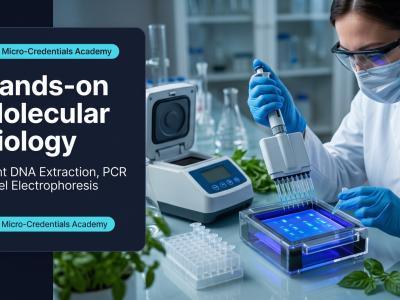
This course provides participants with practical, hands-on skills in extracting genomic DNA from plant tissue using the CTAB method and performing PCR amplification, enabling them to apply foundational molecular biology techniques in research, diagnostics, and breeding programs. Delivered through hands-on workbench practicums, the training bridges the gap between academic theory and practical lab execution in agri-biotech and food safety.
Evidence of Demand
There is a growing need for hands-on molecular biology skills among students in Agriculture, Biotechnology, Genetic Engineering, and Public Health Nutrition disciplines. DNA extraction and PCR are foundational techniques widely required in plant breeding, GMO detection, disease diagnostics, and research labs, yet many students lack practical, workbench-level exposure to these methods. The increasing use of molecular tools in the agri-biotech and food safety sectors reflects a clear and growing skills demand among students and early-career researchers.
Course Objectives
This course aims to:
Equip participants with practical, hands-on skills in extracting genomic DNA from plant tissue using the CTAB method.
Train learners to perform PCR amplification and verify target genes.
Enable application of foundational molecular biology techniques in research, diagnostics, and breeding programs.
Provide practical workbench-level laboratory training in quality and purity assessments.
Course Content & Class Plan (Modules)
Module 1: Introduction to Plant Molecular Biology and Lab Safety (2 hrs)
Module 2: DNA Extraction – Plant Sample Preparation and Cell Lysis (2–3 hrs)
Module 3: DNA Purification and Precipitation (2–3 hrs)
Module 4: DNA Resuspension & Quality/Quantity Assessment (2 hrs)
Module 5: Principles of PCR (2 hrs)
Module 6: PCR Setup and Thermal Cycling (2 hrs)
Module 7: Agarose Gel Preparation, Gel Electrophoresis and Analysis (2 hrs)
Module 8: Applications, Documentation and Capstone (2 hrs)
Practical & Field Work (60% of Course)
Plant Sample Preparation & Cell Lysis using liquid nitrogen and CTAB extraction protocols.
DNA Purification, Precipitation, and Resuspension in TE buffer.
DNA Concentration and Purity Assessment via spectrophotometry ($A_{260}/A_{280}$).
PCR Master Mix setup, primer addition, MgCl2 optimization, and thermal cycler operation.
Casting agarose gels, loading samples, running electrophoresis, and documenting bands using gel imaging systems.
Comprehensive Capstone: Complete extraction-to-gel workflow with results presentation.
Learning Outcomes
After completing the course, participants will be able to:
Extract high-quality genomic DNA from plant tissue using the CTAB method.
Determine DNA concentration and purity using spectrophotometry ($A_{260}/A_{280}$).
Amplify a target gene through PCR and verify amplification by agarose gel electrophoresis.
Target Audience & Requirements
Target Audience:
Undergraduate and postgraduate students and researchers in Agriculture, Biotechnology, Genetic Engineering, Botany, Microbiology, and Public Health Nutrition.
Background in Agriculture, Biotechnology, Genetic Engineering, or related life science disciplines.
Basic interest in molecular biology laboratory techniques (no prior advanced workbench certification required).
Career Pathways
After completing this micro-credential, learners may:
Work as Research Assistant, Molecular Biology Lab Technician, Biotechnology Researcher, Plant Breeder/Geneticist, or Quality Control Analyst (Agri-Biotech/Food Safety).
Progress to Advanced Micro-Credentials, Higher Study, or Professional Certifications in genomics and molecular diagnostics.
Tools & Resources
Facilities & Equipment:
Centrifuge, micropipettes, water bath/heating block.
Thermal cycler (for PCR amplification).
Agarose gel electrophoresis setup and gel documentation/imaging system.