Jagadish Chandra Saha : Technical Consultant, BHP Project, IIC, Daffodil International University
MUZAHIDUL ISLAM MAMUN : Assistant Administrative Officer, Industrial Innovation Centre (IIC), Daffodil International University
Duration: 8 Weeks (Approx. 20 hours total)
Mode of Delivery: Blended (Online theory + Extensive Physical Fieldwork at an Apiary/DIU Green Campus) |
Class Day: Weekends (Friday/Saturday) to facilitate outdoor field visits.
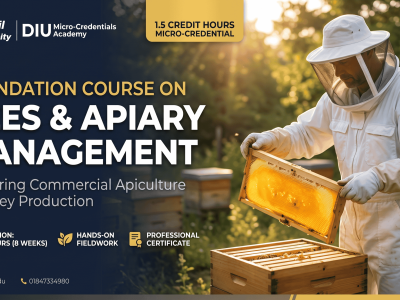
The Foundation Course on Bees and Apiary Management addresses the rapidly growing demand for specialized modern apiculture by delivering an production-centric curriculum. This course transforms learners through deep biological insight and hands-on yard capabilities, covering everything from queen-worker dynamics and physical hive construction to disease eradication, migratory seasonal flora routing, and food-grade extraction techniques. Through rigorous physical labs, field checklists, and direct handler mentorship, participants build the capabilities necessary to maximize honey production while driving environmental balancing and climate resilience.
There is a rapidly growing local and global demand for pure, organic honey. Beekeeping (apiculture) is a highly profitable agro-entrepreneurship venture that requires minimal land ownership. As the agricultural sector modernizes, there is a strong demand for trained individuals who can scientifically manage bee yards (apiaries) and maximize honey yield without harming local ecosystems. Moreover, beekeeping activities enrich ecosystems, food safety, and food security. Environmental balancing and climate resilience serve as primary outcomes to create self-employment as a part of agro-industrial activities.
This course aims to equip learners with the practical skills and biological knowledge required to safely establish an apiary, manage bee colonies, and harvest high-quality honey.
Objectives:
Understand bee biology, colony dynamics, and the roles of different bees.
Learn to select, set up, and manage a scalable apiary.
Master the safe handling of bees using proper equipment.
Identify and treat common bee diseases and pests.
Perform safe and hygienic honey harvesting and extraction.
Module 01: Preamble and Socio-Economic Impact of Beekeeping – Beekeeping objectives, benefits, history, importance, and practical overview.
Module 02: Introduction to Apiculture and Bee Biology – Comparative description of A. mellifera and A. cerana; colony dynamics (Queen, Worker, Drone roles); life history, labor division, and communication.
Module 03: Apiary Setup & Essential Equipment – Site selection parameters (sunlight, water, flora proximity); Langstroth moveable-frame hive architecture (brood/super chambers, excluders); PPE usage and smoker orientation.
Module 04: Colony Installation & Routine Inspection (Practical Focus) – Installing packaged bees or nucleus colonies (Nuc) into new hives; rules of hive engagement, weather boundaries, and safe colony approach.
Module 05: Colony Inspection and Seasonal Nursing – Pre-honey flow, Summer, and Rainy season nursing protocols; reading frames (brood states, pollen stores, capped honey); queen health evaluations.
Module 06: Apiary Management, Growth and Control – Handling colony absconding and swarming (symptoms, causes, prevention); colony uniting processes, benefits, and drawbacks.
Module 07: Bee Plants, Bee Feeding and Dearth Period Management – Flora mapping and migratory beekeeping logistics (Mustard, Litchi, Coriander fields); artificial feeding methods and dearth management.
Module 08: Colony and Bee Health Management 1 – Managing hive predators and invaders (wax moths, ants, wasps, birds); Varroa and Tracheal mite diagnostics, symptoms, and treatments.
Module 09: Colony and Bee Health Management 2 – Recognizing critical bacterial/fungal diseases (American Foulbrood - AFB, European Foulbrood - EFB); managing Acarine, Nosema, Chalkbrood, and food starving.
Module 10: Field Capstone (Live Apiary Visit) – Practical field trip executing protective gearing, live frame inspection, managing accessories, practical honey harvesting, and visiting an active honey processing plant.
Live Apiary Coding Operations: Mandatory physical fieldwork requiring students to don protective gear, light smokers, open live hives, remove active combs, and map colony architectures under direct supervisor monitoring.
Colony Handling Labs: Hands-on practice in installing nucleus colonies, executing cross-box colony integration routines, and mixing artificial starvation feed.
Extraction Processing Sprints: Operating manual honey extractors, performing real-time moisture tests on harvested honey, and testing sanitation safety zones.
Upon successful completion, participants will be able to:
Independently establish and maintain a functional apiary.
Safely open, inspect, and manage active bee hives.
Maximize honey production through seasonal flora management.
Harvest, extract, and process honey maintaining food-grade hygiene in all aspects.
Target Audience:
Agriculture and Nutrition students.
Aspiring agro-entrepreneurs and rural youth.
Hobbyists looking to start commercial backyard or urban beekeeping.
GO and NGO workers involved in rural and/or urban livelihood development.
Entry Requirements:
Minimum SSC or equivalent.
Basic physical fitness and comfort working outdoors.
Crucial Prerequisite: Must not have a known severe allergic reaction (anaphylaxis) to bee stings.
Minimum Age: 18 Years.
Advanced Study: Learners can progress to the "Micro-Credential in Project Management of Honey Production" to scale technical skills into full corporate business models, or pursue higher apiculture studies home and abroad.
Professional Careers: Start an independent commercial apiary business, work as a professional Apiary Manager for small, medium, or large agro-farms, or operate as an agricultural consultant for development NGOs.
Research: Serves as a direct pathway into academic research in entomology, pollination ecology, and commercial apiculture.
Practical Handling Test (40%): On-site physical evaluation of colony inspection, nursing, disease identification, smoker control, and honey moisture testing.
Quiz / Assignment (30%): Regular knowledge checks covering bee biology, hive architecture, and disease identification.
Field Observation Report (30%): Formulation of a professional logbook documenting the health, status, and flora metrics of an active apiary.
Equipment & Protective Gear: Full-body protective bee suits, specialized mesh veils, heavy gloves, smokers, and steel hive tools.
Infrastructure Arrays: Standard wooden Langstroth hives, brood frames, foundation wax sheets, food-grade honey containers, and manual honey extractors with accessories.
Live Biological Assets: Active bee colonies (Apis mellifera or Apis cerana) situated within designated green spaces.
Class Size: Max 20-25 participants per batch (strictly limited for safety during live apiary operations).
Tentative Course Fee:
DIU Students: BDT 1,000/=
External Professionals: BDT 2,500/=
Certification: Professional Micro-Credential Certification issued by DIU-MCA upon successful fulfillment of all field benchmarks.


Join thousands of students already enrolled
Lifetime Support
Certificate included
