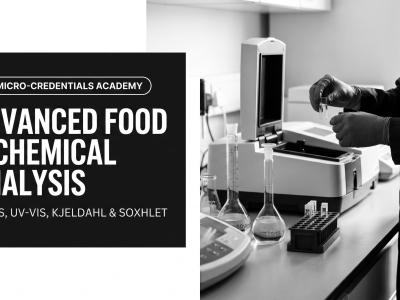
⏱ Duration: 20 Hours (10 Classes; 2 Hours per Class) | Mode: In-person, Laboratory-Based (Hands-on Instrumentation Training)
Instructor
Dr. Farzana Rahman, Assistant Professor, Department of Nutrition and Food Engineering, Faculty of Health and Life Sciences, Daffodil International University (DIU).
Mohammad Khairul Islam, M.Phil (External Expert), Senior Scientific Officer, Wazed Miah Science Research Centre, Jahangirnagar University, Savar, Dhaka.
Course Description
This intensive, laboratory-based micro-credential course provides hands-on instrumentation training across five of the most widely used analytical platforms in food, pharmaceutical, and chemical testing laboratories: Infrared (IR) Spectroscopy, Atomic Absorption Spectroscopy (AAS), UV-Vis Spectrophotometry, Kjeldahl protein determination, and Soxhlet fat extraction. Through small-group, Standard Operating Procedure (SOP)-based sessions, learners progress directly from theoretical instruction to independent sample preparation, instrument operation, method validation, and analytical data reporting.
Evidence of Demand
Bangladesh's food, pharmaceutical, agro-processing, and export-oriented industries increasingly require quality control (QC) and quality assurance (QA) personnel who can independently operate core analytical instruments, yet most undergraduate curricula expose students to these techniques only theoretically or through limited demonstration sessions. Regulatory and certification bodies—such as BSTI, BAB-accredited testing laboratories, and export quality certification agencies—require documented proficiency in standard analytical methods including IR, AAS, UV-Vis spectrophotometry, Kjeldahl protein determination, and Soxhlet fat extraction, creating a persistent gap between graduate knowledge and industry/laboratory expectations. This micro-credential course directly addresses that gap by producing job-ready analytical personnel, supporting Bangladesh's food safety, pharmaceutical, and export quality-assurance ecosystem while strengthening the employability of science graduates.
Purpose and Objectives
This course aims to:
Specific: Enable learners to understand the working principles of, and independently operate, IR, AAS, UV-Vis spectrophotometry, Kjeldahl protein determination, and Soxhlet fat extraction for food and chemical sample analysis.
Measurable: Ensure learners can independently perform complete analytical runs across the core techniques and correctly interpret and report results for a minimum of three sample types.
Achievable: Equip learners with practical instrumentation skills through small-group, SOP-based hands-on laboratory sessions, stepwise demonstrations, and supervised practice on each instrument.
Relevant: Prepare learners for quality assurance/quality control roles in food, pharmaceutical, and chemical testing laboratories, and for research-based analytical work, by providing industry-aligned instrumentation competence.
Time-bound: By the end of the 20-hour course, ensure learners demonstrate full proficiency in sample preparation, instrument operation, and data interpretation, assessed through practical exams, a group analytical project, and viva.
Course Content & Class Plan (Modules) A 20-hour structured laboratory curriculum delivered across 10 sessions (2 hours each):
Session 1: Orientation, Lab Safety & Analytical Overview – Course introduction, laboratory safety and hygiene protocols, overview of analytical instrumentation in food and chemical testing, and Q&A.
Session 2: UV-Vis Spectrophotometry – Principles of UV-Vis spectrophotometry, sample preparation, calibration curves, and hands-on quantification of colored/UV-active analytes.
Session 3: Infrared (IR) Spectroscopy – Principles of IR spectroscopy, ATR sample preparation, hands-on IR operation, and functional group spectral interpretation.
Session 4: Atomic Absorption Spectroscopy (AAS) – Principles of AAS (flame vs. graphite furnace techniques) and hands-on mineral/trace-element analysis.
Session 5: Kjeldahl Protein/Nitrogen Determination – Digestion, distillation, and titration workflows for protein/nitrogen estimation with hands-on execution.
Session 6: Soxhlet Fat/Oil Extraction – Extraction principles, apparatus assembly, solvent selection, hands-on fat/oil extraction, and gravimetric determination.
Session 7: Method Validation & QA/QC Practices – Data handling, calibration, basic method validation concepts (linearity, LOD/LOQ), and QA/QC practices in analytical laboratories.
Session 8: Industry Case Studies – Food adulteration detection, nutrition-label verification, and export quality certification applications.
Session 9: Multi-Technique Group Analytical Project & Troubleshooting – Complete multi-technique analysis of a real food or chemical sample, report writing, data presentation, and troubleshooting common instrument errors.
Session 10: Final Assessment – Practical examination, group project presentation, and viva.
Practical
SOP-Based Instrument Operation: Small-group, hands-on operation of UV-Vis, IR (with ATR accessory), and AAS spectrometers for quantitative and qualitative chemical profiling.
Wet-Chemistry & Compositional Extraction Labs: End-to-end execution of Kjeldahl digestion/distillation/titration for crude protein and Soxhlet solvent extraction for gravimetric lipid analysis.
Calibration & Validation Exercises: Constructing standard calibration curves, determining Limits of Detection/Quantification (LOD/LOQ), and verifying linearity on real sample matrices.
Multi-Technique Capstone Analysis: Conducting a complete quality, nutrition-label, or adulteration investigation on a real food or chemical sample and compiling a professional analytical laboratory report.
Learning Outcomes
After completing the course, participants will be able to:
Explain the underlying principles of IR, AAS, UV-Vis spectrophotometry, Kjeldahl, and Soxhlet techniques.
Independently prepare samples and operate each instrument following Standard Operating Procedures (SOPs).
Interpret spectra, calibration data, and titrimetric/gravimetric data to determine sample composition.
Apply appropriate quality assurance and quality control (QA/QC) practices during analytical procedures.
Prepare a professional analytical report summarizing results obtained across multiple techniques.
Target Audience & Requirements
Target Audience:
Undergraduate and graduate students of Food Engineering, Food Technology, Chemistry, Biochemistry, Nutrition and Food Science, and Pharmacy.
Laboratory professionals and QA/QC personnel from food, chemical, and pharmaceutical industries.
Early-career researchers seeking hands-on instrumental competence.
Entry Requirements:
Science background (Chemistry/Biology at HSC level or equivalent).
Basic laboratory familiarity is preferred but not mandatory.
Minimum Age: 18 Years.
Career Pathways
After completing this micro-credential, learners may:
Work in entry- to mid-level roles as a QA/QC Analyst or Laboratory Technologist in food, pharmaceutical, and chemical industries.
Secure internships and industrial training in BAB-accredited testing laboratories, BSTI, and export quality control units.
Build a career as an Analytical/Instrumentation Specialist, Laboratory Supervisor, or Method-Validation Officer.
Pursue higher studies or advanced research in analytical chemistry, food science, or pharmaceutical/instrumental analysis, or progress toward vendor-specific instrumentation certifications.
Tools & Resources
Facilities & Equipment:
Dedicated analytical testing laboratories equipped with fume hoods and multimedia-supported classrooms.
Infrared (IR) Spectrometer with ATR accessory.
Atomic Absorption Spectrophotometer (AAS).
UV-Vis Spectrophotometer.
Kjeldahl digestion and distillation unit.
Soxhlet extraction apparatus.
Tools, Instruments & Materials:
Analytical-grade chemical reagents, solvents, and certified reference standards.
Volumetric glassware and sample preparation tools.
Laboratory safety equipment (PPE, fume hood, chemical spill kit).
Learning Materials:
Instrument SOP manuals, calibration worksheets, method validation guides, and DIU Learning Management System (LMS) access.
Assessment Criteria
Practical / Laboratory Performance Evaluation
Analytical Report Writing
Group Project Presentation (Multi-technique sample analysis)
Quizzes
Final Viva
Financial Information, Remuneration & Certification
Tentative Course Fee: BDT 3,000
Certification: Micro-Credential Certificate issued by DIU Micro-Credentials Academy (DIU-MCA) upon successful completion of practical evaluations, project report, and viva


Join thousands of students already enrolled
Lifetime Support
Certificate included
